The risk of severe injury or death when a roof hatch opening is left unprotected is why OSHA regulations have stringent stipulations for these access points. The good news is some solutions allow building owners to meet the requirements.
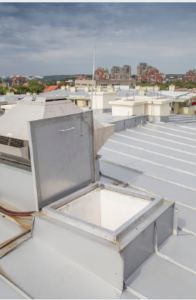 One way to comply is by installing a safety railing around the open end of a rooftop hatch. But there are other options as well. For more information about the roof access hatches safety standards, click here.
Lifting Mechanisms
Roof access hatches can be installed with a variety of lifting mechanisms. These can be used to keep the hatch open or closed after a worker has passed through, protecting against unwanted and criminal activity, preventing accidents caused by lack of knowledge, experience or skill in the use of the roof access hatch or equipment, and satisfying code requirements and workplace safety standards (such as the Canadian Occupational Health and Safety Act or CCOHS).
A gas-charged opening device eliminates the need for two hands to operate a hatch door, reducing the risk of falling out of the building due to an accidental loss of balance. It can also make a manual operation more accessible and less stressful for workers with trouble standing on the ladder.
Another solution for reducing these accidents is installing railing systems around the access hatch. It protects against falls and satisfies the requirement for a guardrail to be present at any exposed sides of a rooftop hole or hatch not covered by a permanent structure such as netting or personal fall protection equipment.
Gas-Charged Opening Devices
Roof access hatches allow workers to quickly enter a building’s upper levels to install, service or repair equipment. The frequency and reason for needing to access a roof area can influence the size of an access hatch and whether or not stair accessibility should be included in a structure’s upper-level design. For more information about the roof access hatches safety standards, click here.
A gas-charged opening device enables personnel to keep both hands free while the hatch door opens. It operates similarly to a gas shock on an aeroplane and is more reliable than manual latches or a spring-loaded hinge. Ladder safety posts are available to supplement railing systems and prevent workers from losing their balance while entering or exiting a roof hatch. These safety devices mount to the top two ladder rungs and provide steady handholds for climbing in and out of a roof hatch.
Ladder Safety Posts
Ladder safety posts are essential for any roof hatch to reduce worker falls. These telescoping posts permanently mount to the top two rungs of any fixed ladder and act as an extension, allowing workers to pass through the hatch in an upright, balanced position. They also lock in the extended position to prevent them from accidentally being lowered down the hatch opening and falling to the floor below.
This ANSI A14.3 compliant Ladder Post by Bilco LU-1 features adjustable mounting hardware to accommodate any ladder rung size and spacing. The telescoping design is spring-balanced and has a handy release lever that allows the post to be easily lowered to its retracted position. It is corrosion-resistant and ships fully assembled. For more information about the roof access hatches safety standards, click here.
The LP-4 model is designed to meet the requirement that a guardrail protect access ladders within 10 feet of any roof edge. This safety ladder post enables users to access the roof from the eave through a hatch without climbing over conduit pipes, which could pose a fall risk and an OSHA willful violation.
Proper Installation
When roof access hatches aren’t installed correctly, they can create a fall hazard for people working on the rooftop. They must be surrounded by safety rails and walkways to keep people from falling through the opening.
Hatches should also have an automatic open lock to hold the hatch in the open position and mitigate hatch operation accidents. They should also have compression springs to counterbalance the weight of the hatch cover. It is essential to lubricate these components regularly to ensure they work smoothly.